
Lighting
50-150 PAR is a starting range; fleshy tissue should expand without paling, stretching, or pulling against skeleton.
Merulina spp.
Merulina Coral care and ID profile for ruffled ridges, plating or encrusting growth, ridge-edge recession, and practical placement decisions for mixed reef compatibility.
Compare ruffled ridges, care range, and nearby lookalikes while checking an ID.
Snapshot
Care note
This entry has low confidence or is marked for expert review. Treat the ranges as conservative starting points and compare them with your own system.
Images
Photos are shown only when a source includes reusable license metadata. Always verify appearance against the coral in your own lighting and flow.
Primary reference: Auckland Museum Collections from Auckland, Aotearoa New Zealand
Source: Wikimedia Commons. License: CC BY 2.0
Photo: Jean-Paul Boerekamps
Source: Wikimedia Commons. License: CC0
Photo: Jean-Paul Boerekamps
Source: Wikimedia Commons. License: CC0
Ranges
These ranges are approximate starting points from the coral database and should be adjusted to the stability and history of your system.
Care
50-150 PAR is a starting range; fleshy tissue should expand without paling, stretching, or pulling against skeleton.
moderate indirect flow should move tissue gently without folding it into sharp skeleton or neighbors.
For Merulina Coral, verify salinity and alkalinity trends before changing placement; repeated moves and direct corrective swings can irritate fleshy tissue.
Merulina Coral requirements vary by specimen, aquaculture history, shipping stress, and tank maturity; use these ranges as starting points, not guarantees.
Feeding
ID
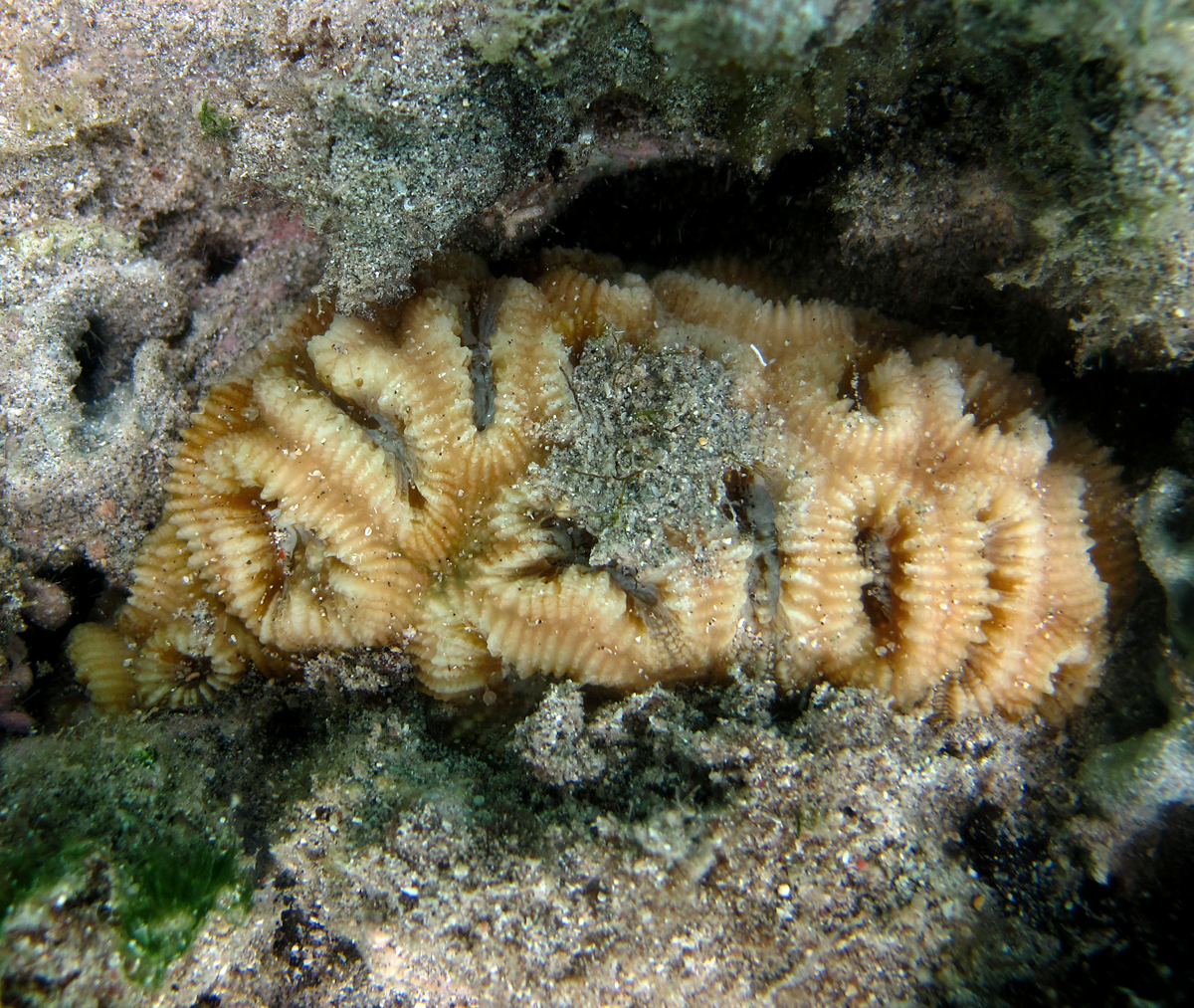
Merulina Coral is best separated from Pectinia Coral and Chalice Coral by weighing ruffled ridges, plating or encrusting growth, and aggressive sweeper potential. Look at corallite walls, polyp shape, tissue inflation, and where recession begins; then compare that structure with where the coral expands, retracts, or shows early recession. Do not rely only on color under blue lighting. Because trade photos can exaggerate color, skeleton shape, polyp layout, and expansion pattern are stronger clues than color alone.
Genus-level identification only. Avoid species-level claims unless a specimen is independently verified.
Sources
Use these references to verify taxonomy and husbandry details against current source material.
Placement
Compatibility depends on specimen size, flow, growth, aggression, and spacing. Use these references conservatively and watch for contact over time.
Spacing recommendation: keep about 6 inches of clearance, then adjust based on extension and neighboring coral response.
Troubleshooting
Use these as troubleshooting checks, not a diagnosis. Symptoms may point to more than one issue.
Checklist
Compare
Neighbors
These corals are usually compatible with spacing, observation, and stable conditions. This is not a guarantee.
Usually compatible with spacing
Favia
Dipsastraea spp. / Favia spp.

Usually compatible with spacing
Favites
Favites spp.

Usually compatible with spacing
Brain Coral
Trachyphyllia spp. / Lobophyllia spp. / Platygyra spp.
FAQs
Merulina Coral is better treated as intermediate because placement, flow, feeding response, or aggression can vary by specimen.
Start Merulina Coral low in the tank or on the sand/low rockwork when its tissue form allows it. Use 50-150 PAR and moderate flow as a starting point, then adjust from tissue extension, color, and nearby coral response.
Merulina Coral may benefit from careful target feeding with small meaty foods, mysis, and LPS pellets. Use the listed frequency as a starting point: weekly when feeding response is visible. Feed only when the coral accepts food and avoid forcing food into stressed tissue.
Give Merulina Coral about 6 inches of clearance as a starting point. Its database aggression level is High. Use caution near Acan Coral, Blastomussa, and Candy Cane Coral. Avoid close placement with Zoanthids, Mushroom Coral, and Acropora. Compatibility is not a guarantee, so check contact points as colonies expand.
Use this as a troubleshooting check. For Merulina Coral, pale or exposed skeleton appears along folded ridges and Merulina Coral shows less normal extension, inflation, or feeding response than its recent baseline can indicate Merulina Coral ridge-edge recession. Likely causes to check include alkalinity instability, detritus settling in folds, or nearby aggression and recent placement, lighting, flow, or chemistry changes affecting Merulina Coral. Start with these database checks: check Merulina Coral alkalinity trend and look for nearby stinging contact and reduce direct flow if tissue is pressed against skeleton.
For Merulina Coral, verify salinity and alkalinity trends before changing placement; repeated moves and direct corrective swings can irritate fleshy tissue. The database lists 4 months as the minimum tank age and 25 gallons as the minimum tank size. For LPS-style care, protect fleshy tissue from repeated moves, direct flow, and abrupt chemistry corrections.
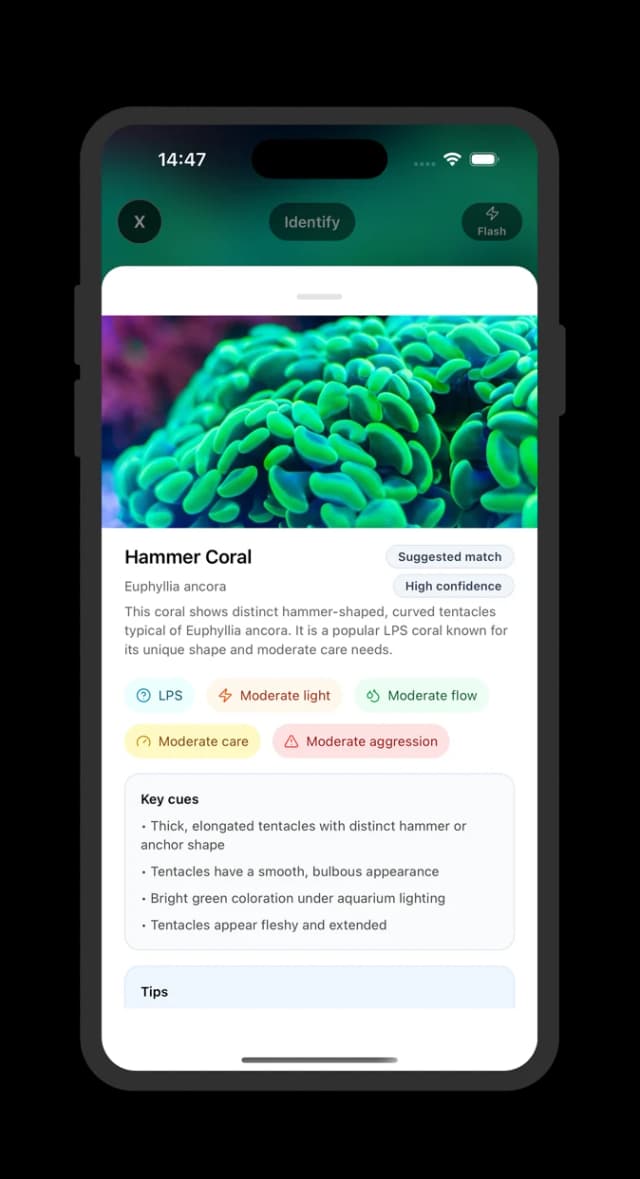
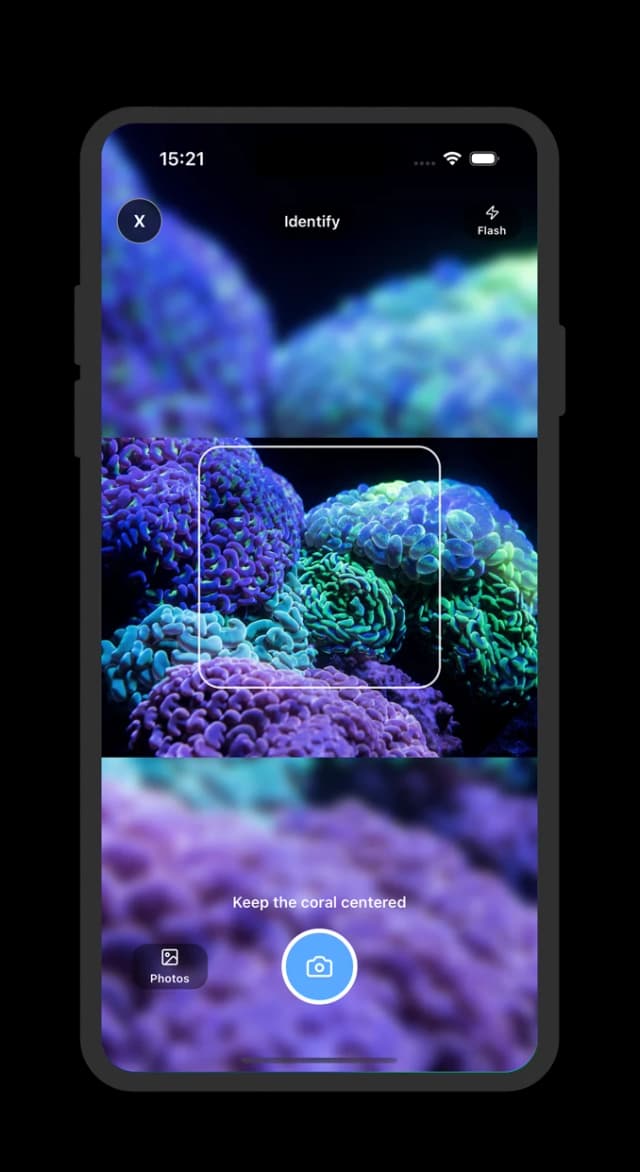
Coral Identifier
Use the app to compare photos, lookalikes, and key visual clues when you want a second pass on an ID.
Compare ruffled ridges, care range, and nearby lookalikes while checking an ID.