
Lighting
Light is not the main energy source; place for feeding access and flow, not display brightness.
Tubastraea spp.
Identify Sun Coral by bright orange or yellow cup corallites and large feeding tentacles; then set low placement, moderate flow, and enough separation from Duncan Coral and Candy Cane Coral.
Compare bright orange or yellow cup corallites, care range, and nearby lookalikes while checking an ID.
Snapshot
Care note
This entry has low confidence or is marked for expert review. Treat the ranges as conservative starting points and compare them with your own system.
Images
Photos are shown only when a source includes reusable license metadata. Always verify appearance against the coral in your own lighting and flow.
Primary reference: Wmpearl
Source: Wikimedia Commons. License: CC0
Photo: Cairns S, Kitahara M (2012)
Source: Wikimedia Commons. License: CC BY 3.0
Photo: Pauline Walsh Jacobson
Source: Wikimedia Commons. License: CC BY 4.0
Ranges
These ranges are approximate starting points from the coral database and should be adjusted to the stability and history of your system.
Care
Light is not the main energy source; place for feeding access and flow, not display brightness.
moderate flow should deliver food and remove waste; dead spots are usually a bigger issue than low light.
For Sun Coral, pair feeding with nutrient export; tissue decline can reflect starvation, water-quality stress, or both.
Sun Coral requirements vary by specimen, aquaculture history, shipping stress, and tank maturity; use these ranges as starting points, not guarantees.
Feeding
ID
Sun coral is non-photosynthetic and has cup-like polyps that require regular feeding, unlike Duncan or candy cane corals. Sun Coral is best separated from Duncan Coral and Candy Cane Coral by weighing bright orange or yellow cup corallites, large feeding tentacles, and opens strongly when fed. Look at polyp structure, feeding response, branch tissue, and dependence on shade and food access; then compare that structure with where the coral expands, retracts, or shows early recession. Do not rely only on color under blue lighting. For NPS corals, bright color is a weak ID shortcut; feeding response, polyp structure, and food access matter more.
Genus-level identification only. Avoid species-level claims unless a specimen is independently verified.
Sources
Use these references to verify taxonomy and husbandry details against current source material.
Placement
Compatibility depends on specimen size, flow, growth, aggression, and spacing. Use these references conservatively and watch for contact over time.
Spacing recommendation: keep about 3 inches of clearance, then adjust based on extension and neighboring coral response.
Troubleshooting
Use these as troubleshooting checks, not a diagnosis. Symptoms may point to more than one issue.
Checklist
Compare
Neighbors
These corals are usually compatible with spacing, observation, and stable conditions. This is not a guarantee.

Usually compatible with spacing
Duncan Coral
Duncanopsammia axifuga

Usually compatible with spacing
Candy Cane Coral
Caulastrea furcata

Usually compatible with spacing
Blastomussa
Blastomussa wellsi / Blastomussa merleti
FAQs
Sun Coral is not a beginner coral. It needs mature-system stability and careful observation, and the listed values should be reviewed before publication.
Start Sun Coral low in the tank or on the sand/low rockwork when its tissue form allows it. Use 0-80 PAR and moderate flow as a starting point, then adjust from tissue extension, color, and nearby coral response.
Sun Coral is listed as an NPS coral, so feeding access matters more than display brightness. Use mysis, brine shrimp, finely chopped seafood, and small meaty foods and the database frequency as a starting point: several times weekly to daily depending on polyp response and nutrient export. Watch polyp response and nutrient export together.
Give Sun Coral about 3 inches of clearance as a starting point. Its database aggression level is Moderate. Use caution near Favia, Favites, and Chalice Coral. Avoid close placement with Torch Coral and Elegance Coral. Compatibility is not a guarantee, so check contact points as colonies expand. For NPS corals, keep enough access for feeding and waste removal, not just enough visual space.
Use this as a troubleshooting check. For Sun Coral, polyps open less often and tissue thins around each cup and Sun Coral shows less normal extension, inflation, or feeding response than its recent baseline can indicate Sun Coral weak feeding response. Likely causes to check include inconsistent target feeding, food size mismatch, or nutrient export not matching feeding load and recent placement, lighting, flow, or chemistry changes affecting Sun Coral. Start with these database checks: confirm Sun Coral polyps can catch appropriately sized food and increase feeding consistency only with nutrient export in place.
For Sun Coral, pair feeding with nutrient export; tissue decline can reflect starvation, water-quality stress, or both. The database lists 6 months as the minimum tank age and 20 gallons as the minimum tank size. For NPS-style care, feeding consistency and nutrient export need to be planned together.
Coral Identifier
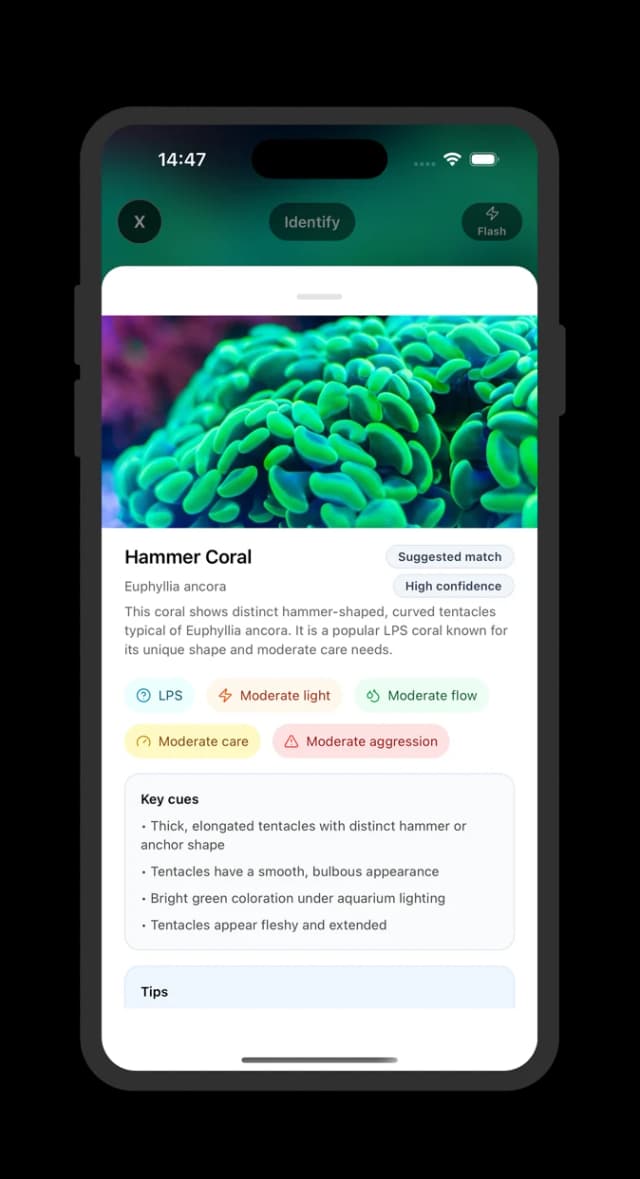
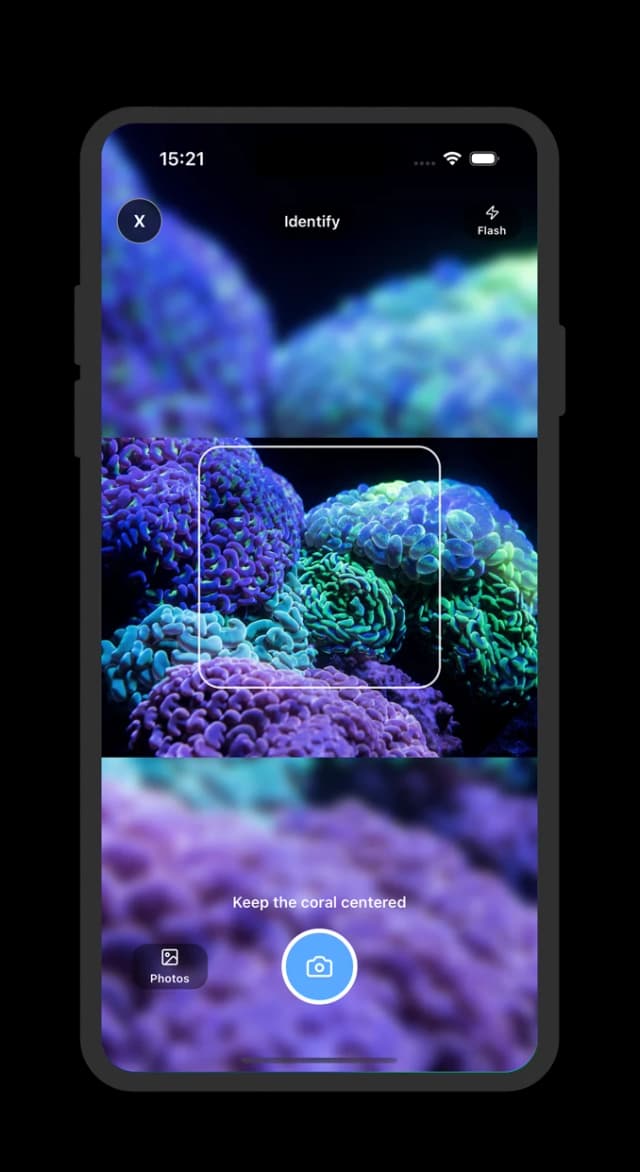
Use the app to compare photos, lookalikes, and key visual clues when you want a second pass on an ID.
Compare bright orange or yellow cup corallites, care range, and nearby lookalikes while checking an ID.