
Short Answer
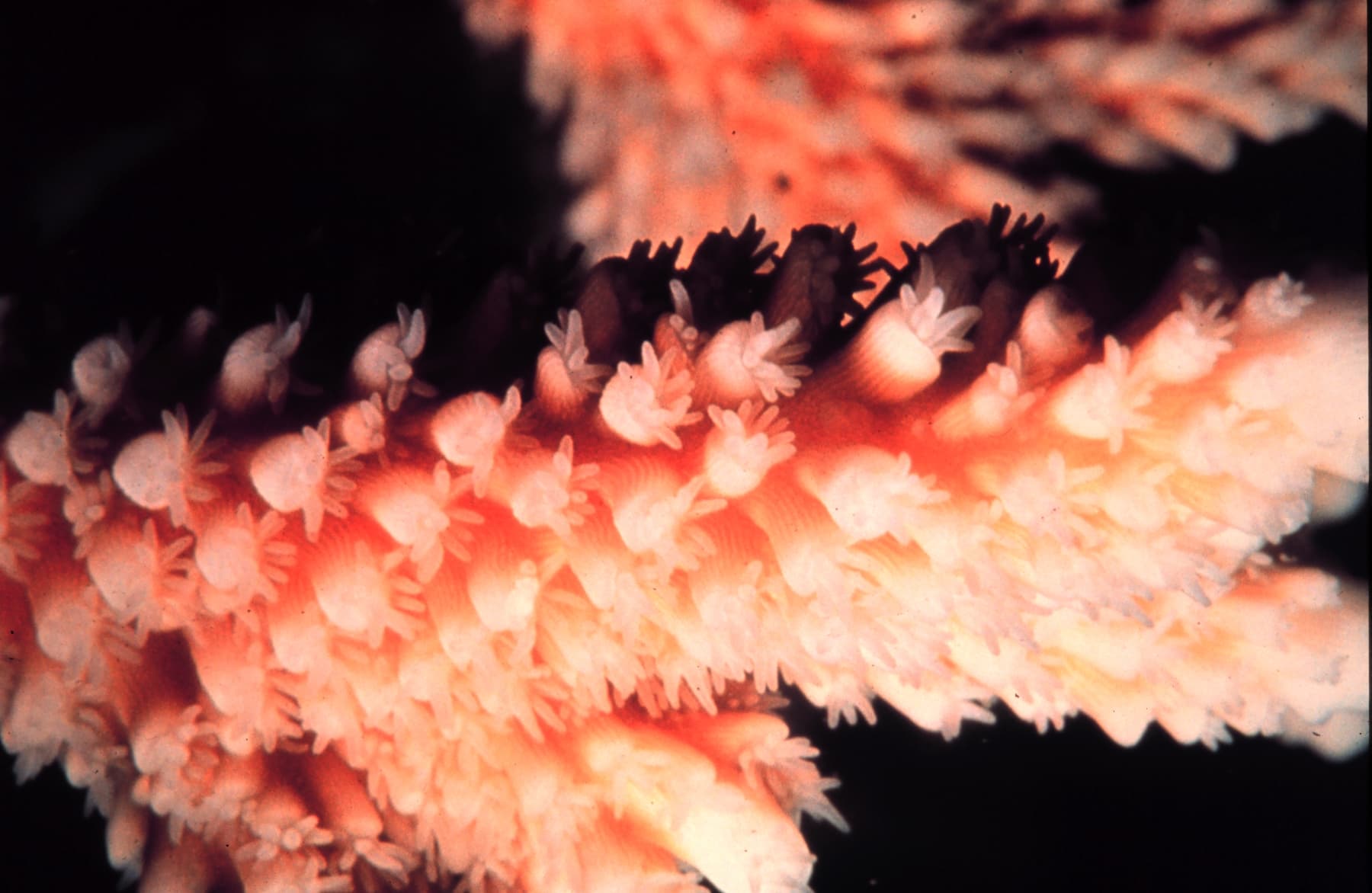
- Acropora usually shows a clear branch-tip axial corallite plus smaller radial corallites along the branch.
- Color names are weak evidence because light spectrum, nutrients, and photo processing can change the look quickly.
- Good ID photos show branch tips, side structure, growth edge, and enough scale to compare corallite spacing.
- For care planning, many Acropora do best in stable SPS systems with strong random flow, high light, and low parameter swing.
How to recognize Acropora first
The Acropora shortcut is branch plus corallite pattern. Many Acropora colonies form upright, bottlebrush, table, bushy, or stag-like structures, but the branch tip is usually the first place to inspect.
A clear axial corallite at the tip, with radial corallites along the branch, is more useful than a vendor color name. If the photo is too blue or too far away to show corallites, keep the ID broad as likely Acropora or branching SPS.
Acropora ID signals
| Signal | What to look for | Why it matters |
|---|---|---|
| Axial corallite | A visible corallite at the branch tip. | One of the strongest practical Acropora clues. |
| Radial corallites | Small corallites along branch sides. | Helps separate Acropora from smoother branching SPS. |
| Growth form | Stag, table, bottlebrush, bushy, or plating branches. | Narrows likely Acropora group but rarely proves species. |
| Polyp extension | Small polyps extending from corallites. | Supports SPS health context but should not be used alone for ID. |
Care context that affects identification
- Fresh frags often hide mature growth form, so species-level ID is usually weak early on.
- High light can compact growth; lower light can stretch or flatten structure.
- Strong random flow can improve branch growth visibility, while one-direction flow may distort the colony.
- Use care ranges as context only: common SPS starting points are roughly 200-350 PAR and strong varied flow, not a species proof.
Confidence gates before calling it Acropora
- High confidence: branch tips show axial corallites and side branches show radial corallites clearly.
- Medium confidence: growth form looks Acropora-like, but corallites are partly hidden by blue light, distance, or blur.
- Low confidence: the coral is only a small branching SPS frag with no branch-tip detail.
- Retake the photo after 4-8 weeks of growth if the frag has not developed a recognizable branch pattern yet.
Common Acropora mislabels to avoid
A coral can be a branching SPS without being Acropora. Pocillopora, Stylophora, Seriatopora, and some branching Montipora can all be sold or remembered loosely as acro by hobbyists.
- Do not upgrade a generic SPS label to Acropora unless the branch-tip structure supports it.
- Do not use a high-end trade name as proof of genus.
- Do not identify a browned-out frag by the color it is expected to become later.
Where AI helps with Acropora
AI can help separate Acropora from Montipora, Pocillopora, Stylophora, and other SPS lookalikes when branch tips and corallites are visible. It is less reliable when the image is a blue macro shot with no branch context.
Use the result as a shortlist, then verify axial corallites, radial corallites, growth form, and photo history before using a precise label.
Try Coral Identifier on your own tank photos
Capture a clear photo, review likely matches, and build better coral ID confidence over time.


Coral database
Compare the coral profiles
Continue with the structured identification, lookalike, placement, and care references for the corals discussed in this guide.
Acropora
Acropora spp.
Compare Acropora reference photos, Montipora and birdsnest lookalikes, and care requirements for light, flow, and water stability.
Open profile →Acropora Tenuis
Acropora tenuis
Acropora Tenuis SPS guide for identifying branching Acropora, choosing high placement with high flow, and managing color-chasing stress and pale tips when kept near Acropora and Acropora Millepora.
Open profile →Acropora Millepora
Acropora millepora
Use this Acropora Millepora profile to compare hairy polyp extension with Acropora and Acropora Tenuis, plan conservative spacing, and watch for reduced hairy polyp extension under high flow.
Open profile →Sources
References and further reading
FAQ
Frequently asked questions
01What is the easiest way to identify Acropora?+
Look for branching SPS structure with a visible axial corallite at the branch tip and radial corallites along the branch. Those clues are stronger than color.
02Can I identify Acropora species from a frag?+
Usually not with high confidence. Small frags often lack mature colony shape, so genus-level or likely-group identification is safer.
03What light level do Acropora usually need?+
Many reef keepers start Acropora in high-light SPS zones around 200-350 PAR, then adjust slowly based on color, growth, and polyp extension.
04Why does my Acropora look different from photos online?+
Lighting spectrum, nutrients, flow, camera processing, and colony maturity can all change color and growth form. Compare structure before color.
05When should I leave an Acropora ID at genus level?+
Leave it at genus level when branch and corallite evidence supports Acropora, but the photo or frag maturity does not support a species-level label.