
Short Answer
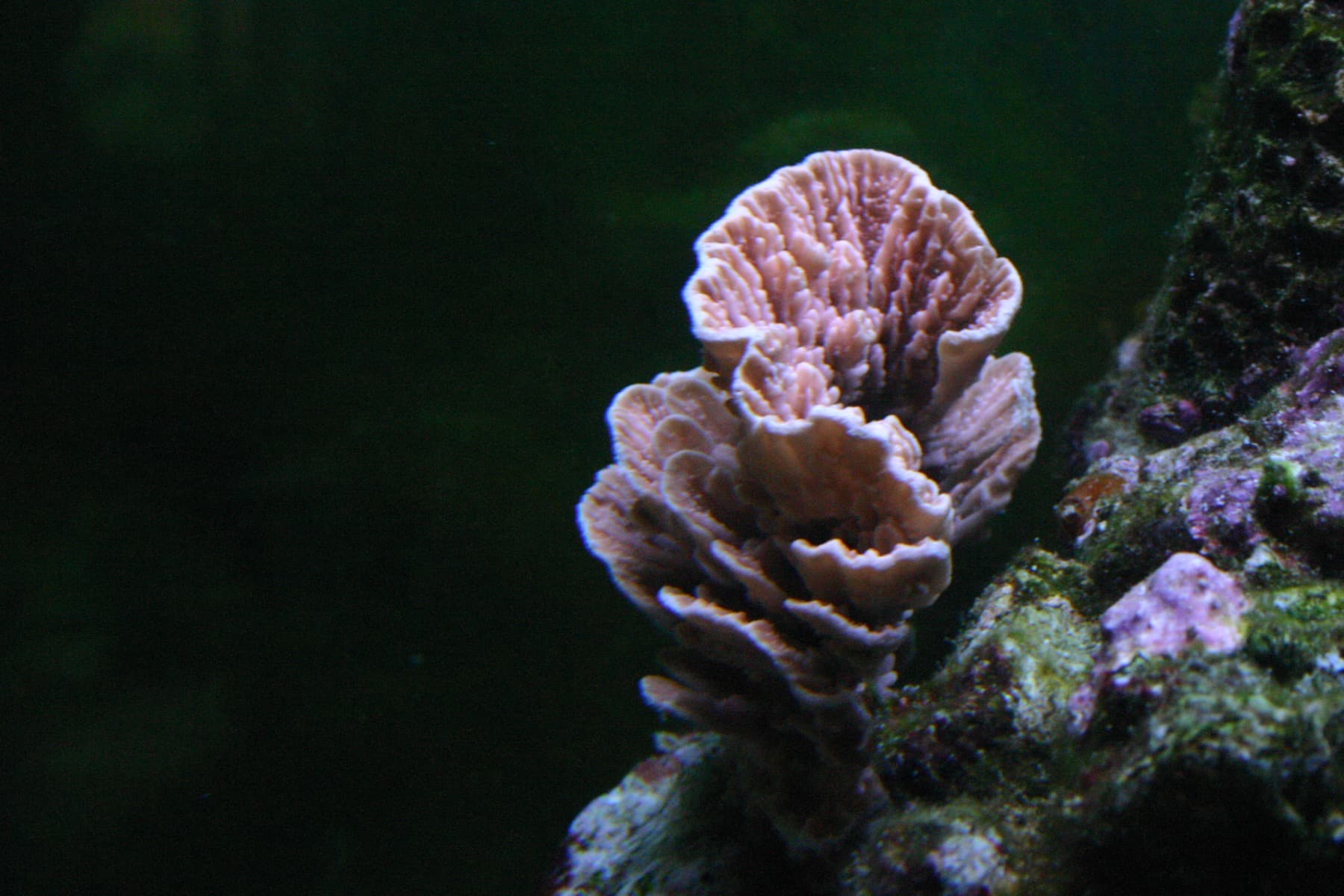
- Montipora often appears as plating, encrusting, branching, or scrolling SPS growth.
- Compared with Acropora, Montipora generally lacks a strong branch-tip axial corallite pattern.
- Look for very small corallites, thin growth edges, and smooth-to-bumpy surface texture.
- A good Montipora ID photo shows the growth edge, side profile, and a close-up of the surface.
Start with Montipora growth form
Montipora is a broad SPS genus in the aquarium trade, so a single visual rule is not enough. The first useful question is whether the coral plates outward, encrusts over rock, branches upward, or forms whorled scrolling layers.
Plating Montipora often makes thin shelves. Encrusting Montipora spreads as a skin over rock. Branching Montipora, often called digitata in the hobby, can form rounded fingers rather than Acropora-like branch-tip structures.
Montipora type comparison
| Type | Visual signal | Common ID trap |
|---|---|---|
| Plating | Thin shelf or cap growth with visible rim. | Confused with chalice when color is the focus. |
| Encrusting | Spreads over rock with small polyps. | Confused with Cyphastrea or Leptoseris. |
| Branching | Finger-like branches, often smoother than Acropora. | Confused with Acropora frags. |
| Scrolling | Whorled or layered plates. | Confused with generic plating coral labels. |
Quick Montipora photo ID path
| Visible shape | Check next | Main lookalike |
|---|---|---|
| Thin plate or cap | Look for a thin growth rim and very small surface polyps. | Chalice or another plating coral. |
| Rounded finger-like branches | Check for small corallites without one dominant axial corallite at each tip. | Acropora. |
| Tissue spreading over rock | Photograph the newest edge and compare corallite spacing. | Cyphastrea or Leptoseris. |
| Whorled or layered shelves | Use a side photo to confirm repeated thin plates. | A generic plating SPS label. |
Care numbers that help interpret appearance
- Many Montipora tolerate moderate-to-high SPS light, often around 150-300 PAR as a starting range.
- Flow should be moderate to strong and varied; dead spots can collect detritus on plating forms.
- Fast growth can hide old edges, so compare the newest rim when identifying plating or encrusting types.
- Alkalinity swings can cause paling or edge recession, which can make ID photos misleading.
How store labels usually map to Montipora forms
| Store wording | Likely form | Verification photo |
|---|---|---|
| Monti cap | Plating Montipora | Side angle showing plate rim and thickness. |
| Digitata | Branching Montipora | Branch tips and surface polyps, not only color. |
| Encrusting monti | Encrusting Montipora | Growth edge where tissue meets rock or plug. |
| Setosa-type | Branching or knobby Montipora-like form | Reduced-blue close-up of texture and growth direction. |
Where AI helps with Montipora
AI helps most when deciding whether an SPS photo is likely Montipora, Acropora, Cyphastrea, or another encrusting/plating coral. It needs both surface detail and growth edge context.
If only the center of the coral is visible, keep the result broad. The edge often carries the most useful evidence for Montipora shape.
Try Coral Identifier on your own tank photos
Capture a clear photo, review likely matches, and build better coral ID confidence over time.


Coral database
Compare the coral profiles
Continue with the structured identification, lookalike, placement, and care references for the corals discussed in this guide.
Montipora Capricornis
Montipora capricornis
Montipora Capricornis care and ID profile for plating whorls, thin cap-like shelves, paling, base recession, or lost polyp extension, and practical placement decisions for mixed reef compatibility.
Open profile →Montipora Digitata
Montipora digitata
Identify Montipora Digitata by branching finger-like growth and small polyps; then set middle placement, high flow, and enough separation from Acropora and Birdsnest Coral.
Open profile →Encrusting Montipora
Montipora spp.
Use this Encrusting Montipora profile to compare thin encrusting SPS mat with Meteor Shower Cyphastrea and Leptoseris Coral, plan conservative spacing, and watch for paling, base recession, or lost polyp extension under high flow.
Open profile →Sources
References and further reading
FAQ
Frequently asked questions
01How do I identify Montipora coral?+
Start with growth form: plating, encrusting, branching, or scrolling. Then inspect small corallites, surface texture, and growth edge shape.
02How is Montipora different from Acropora?+
Acropora commonly shows a more obvious branch-tip axial corallite, while Montipora often has smoother branches, plates, or encrusting surfaces with small corallites.
03Can Montipora be encrusting?+
Yes. Many Montipora grow as encrusting sheets over rock, which can make them easy to confuse with Cyphastrea, Leptoseris, or other encrusting corals.
04What photos help identify Montipora?+
Use one side-angle photo showing the growth edge and one close-up showing the surface texture and small polyps.