
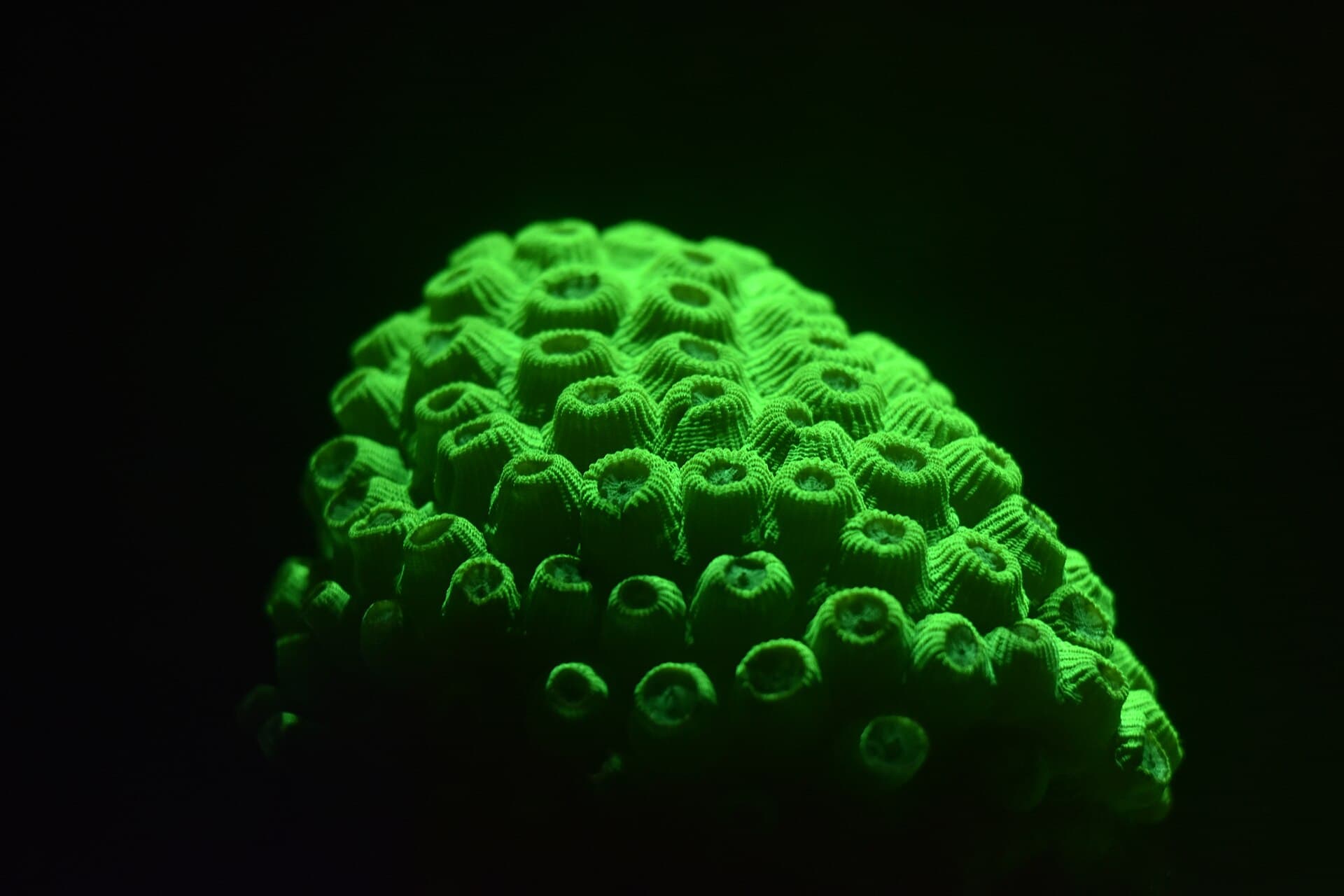
Short Answer
- Blue light can make different corals look more similar by emphasizing fluorescence over structure.
- Phone cameras often over-process actinic photos, changing saturation and white balance.
- Identification should rely on growth form, tentacle shape, and skeleton clues before color.
- The fix is simple: take one normal tank photo and one reduced-blue or white-balanced photo.
Blue light emphasizes glow over structure
Reef tanks often use blue-heavy lighting because it brings out coral fluorescence. That is useful for viewing and photography, but it can overpower the subtle shape cues used for identification.
When fluorescence dominates the image, tentacle edges, corallite walls, skeleton texture, and tissue boundaries can become harder to read. The photo may look beautiful while carrying less ID evidence.
How blue light affects coral ID photos
| Problem | What it does | Better evidence |
|---|---|---|
| Fluorescence dominance | Makes glow and color look more important than shape. | Reduced-blue image showing tissue and structure. |
| White balance shift | Turns natural colors into heavy blue or neon tones. | Manual white balance or orange filter comparison. |
| Phone processing | Over-sharpens, saturates, or crushes shadows. | Multiple photos with exposure lowered slightly. |
| Hidden skeleton clues | Makes walls, branches, and corallites harder to separate. | Side-angle image with less actinic intensity. |
A better photo method for coral identification
- Take the first photo under your normal display lighting for context.
- Take a second photo with blues reduced or whites increased.
- Lower exposure if glowing tips are blown out.
- Use a side angle when skeleton, wall, or branch structure matters.
- Do not judge a trade name from the most fluorescent photo alone.
How AI can misread blue-light coral photos
AI systems can be affected by the same visual problem as humans: if the image mainly shows glow, the model has less structural information to compare. It may still suggest a plausible match, but confidence should stay lower.
The best use of AI is to compare the blue-light photo with a reduced-blue photo of the same coral. If the likely match stays consistent across both, the result is more useful.
Try Coral Identifier on your own tank photos
Capture a clear photo, review likely matches, and build better coral ID confidence over time.


Sources
References and further reading
FAQ
Frequently asked questions
01Can blue light make coral identification wrong?+
Yes. Blue light can hide structure, exaggerate fluorescence, and distort color, which can lead to weak or incorrect coral ID guesses.
02Should I turn off blue lights for coral ID photos?+
You do not need to turn them off completely, but you should take an additional reduced-blue or white-balanced photo so structure is easier to see.
03Do orange filters help with coral identification?+
They can help by reducing the blue cast and making tissue boundaries easier to see, but they should support structural ID rather than replace it.
04Why do coral colors look different on my phone?+
Phone cameras often adjust white balance, saturation, contrast, and exposure automatically. Under actinic lighting, those changes can make coral colors look less reliable for identification.