
Lighting
80-220 PAR is a flexible starting range; growth control and steady flow usually matter more than exact PAR.
Sarcophyton spp.
Toadstool Leather soft coral guide for identifying mushroom-like cap, choosing middle placement with moderate flow, and managing closure, shedding, or tissue slump when kept near Leather Coral and Kenya Tree Coral.
Compare mushroom-like cap, care range, and nearby lookalikes while checking an ID.
Snapshot
Care note
This entry has low confidence or is marked for expert review. Treat the ranges as conservative starting points and compare them with your own system.
Images
Photos are shown only when a source includes reusable license metadata. Always verify appearance against the coral in your own lighting and flow.
Primary reference: Diego Delso
Source: Wikimedia Commons. License: CC BY-SA 4.0
Photo: Diego Delso
Source: Wikimedia Commons. License: CC BY-SA 4.0
Photo: Diego Delso
Source: Wikimedia Commons. License: CC BY-SA 4.0
Ranges
These ranges are approximate starting points from the coral database and should be adjusted to the stability and history of your system.
Care
80-220 PAR is a flexible starting range; growth control and steady flow usually matter more than exact PAR.
moderate flow should help shedding and detritus removal while avoiding constant collapse of the colony.
For Toadstool Leather, review salinity, nutrient swings, and flow before assuming decline; temporary closure, shedding, or posture changes can be normal.
Toadstool Leather requirements vary by specimen, aquaculture history, shipping stress, and tank maturity; use these ranges as starting points, not guarantees.
Feeding
ID
Toadstools have a distinct stalk and cap, unlike branching Kenya tree or lobed leather forms. For Toadstool Leather, start with mushroom-like cap, central stalk, and short polyps on cap before checking color. Compare it with Leather Coral and Kenya Tree Coral by looking at mat or branch structure, polyp arrangement, surface shedding, and spread pattern, especially after polyps or tissue are fully extended. For soft corals, growth habit, polyp arrangement, and shedding behavior are usually more useful than a loose trade name.
Genus-level identification only. Avoid species-level claims unless a specimen is independently verified.
Sources
Use these references to verify taxonomy and husbandry details against current source material.
Placement
Compatibility depends on specimen size, flow, growth, aggression, and spacing. Use these references conservatively and watch for contact over time.
Spacing recommendation: keep about 4 inches of clearance, then adjust based on extension and neighboring coral response.
Troubleshooting
Use these as troubleshooting checks, not a diagnosis. Symptoms may point to more than one issue.
Checklist
Compare
Neighbors
These corals are usually compatible with spacing, observation, and stable conditions. This is not a guarantee.

Usually compatible with spacing
Zoanthids
Zoanthus spp.

Usually compatible with spacing
Mushroom Coral
Discosoma spp. / Rhodactis spp.
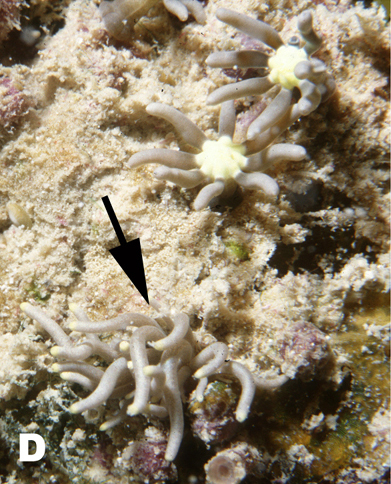
Usually compatible with spacing
Green Star Polyps
Pachyclavularia violacea / Briareum violaceum
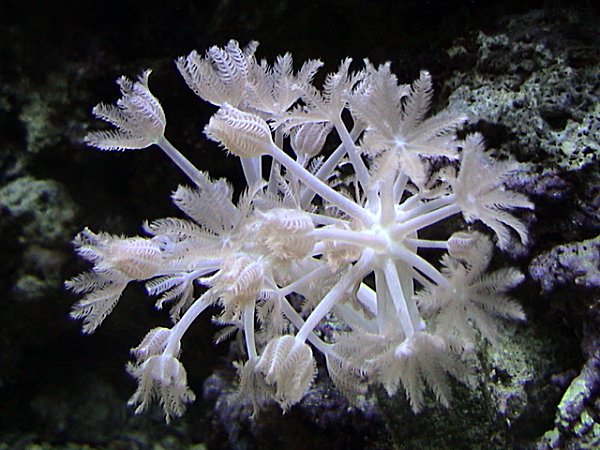
Usually compatible with spacing
Xenia
Xenia spp.
FAQs
Toadstool Leather can be beginner friendly in a stable reef, but still needs acclimation, space, and observation after moves.
Start Toadstool Leather in the middle third with room to adjust up or down. Use 80-220 PAR and moderate flow as a starting point, then adjust from tissue extension, color, and nearby coral response.
Toadstool Leather does not usually need direct feeding. The database lists dissolved nutrients and fine suspended foods and notes: direct feeding not usually needed. For soft-coral style care, stable nutrients and enough flow to keep surfaces clean are the main checks.
Give Toadstool Leather about 4 inches of clearance as a starting point. Its database aggression level is Moderate. Use caution near Acropora and Goniopora. Avoid close placement when neighboring corals can make direct contact. Compatibility is not a guarantee, so check contact points as colonies expand. For spreading or mat-forming corals, also watch the edge of the colony so it does not grow into neighbors unnoticed.
Use this as a troubleshooting check. For Toadstool Leather, polyps stay closed, surface film appears, or branches look limp and Toadstool Leather shows less normal extension, inflation, or feeding response than its recent baseline can indicate Toadstool Leather closure, shedding, or tissue slump. Likely causes to check include normal shedding, salinity change, low indirect flow, or chemical irritation in a mixed reef and recent placement, lighting, flow, or chemistry changes affecting Toadstool Leather. Start with these database checks: check whether Toadstool Leather is shedding before moving it and improve indirect flow across the surface or branches.
For Toadstool Leather, review salinity, nutrient swings, and flow before assuming decline; temporary closure, shedding, or posture changes can be normal. The database lists 2 months as the minimum tank age and 20 gallons as the minimum tank size. With soft corals, temporary closure or posture changes can happen, so compare against the recent baseline before moving it repeatedly.
Coral Identifier
Use the app to compare photos, lookalikes, and key visual clues when you want a second pass on an ID.
Compare mushroom-like cap, care range, and nearby lookalikes while checking an ID.