
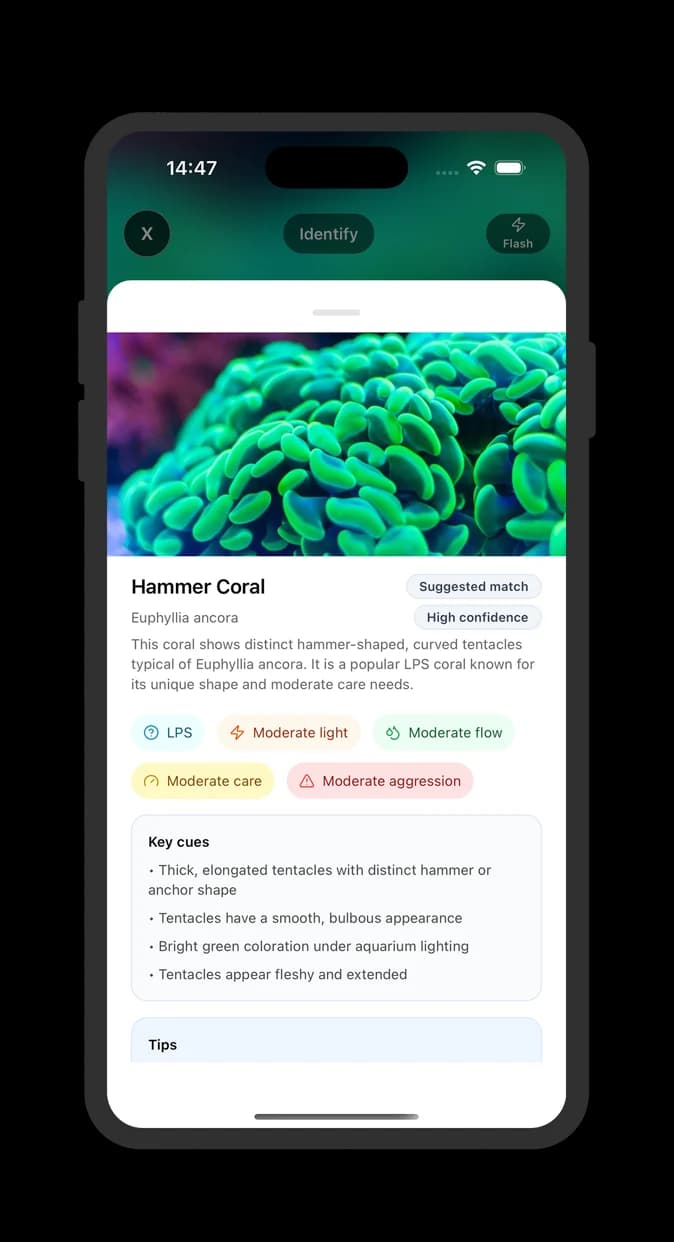
Short Answer
- Start broad: soft, LPS, SPS, zoa/paly, mushroom, plating, encrusting, or unknown.
- Take four photos before asking for an ID: normal light, reduced-blue, side angle, and close-up.
- Use color after structure, not before it.
- End every beginner ID with a confidence level: low, medium, or high.
The 10-step coral ID checklist
- 1. Is there a hard skeleton or only soft tissue?
- 2. What is the growth form: branching, plating, encrusting, wall, disc, mat, or fleshy head?
- 3. Are the polyps large, small, skirted, bubbly, or tentacled?
- 4. Does the coral have visible mouths, eyes, corallites, or branches?
- 5. Is the coral open, closed, feeding, sweeping, pulsing, or spreading?
- 6. What does it look like under reduced-blue lighting?
- 7. How large is the frag or colony?
- 8. What was it sold as?
- 9. What care group does it likely belong to?
- 10. What confidence level does the evidence support?
Beginner confidence levels
| Confidence | Use when | Example label |
|---|---|---|
| Low | Only color or one poor photo is available. | Unknown LPS-type coral. |
| Medium | Growth form and polyps support a likely group. | Likely hammer coral. |
| High | Multiple traits, photos, and source context agree. | Hammer coral, sold as green branching hammer. |
Common beginner mistakes
- Starting with color names before growth form.
- Trusting one blue-light photo.
- Forcing species-level certainty from a small frag.
- Ignoring whether the coral is closed, stressed, or recently moved.
- Assuming a store label is a verified scientific name.
Try Coral Identifier on your own tank photos
Capture a clear photo, review likely matches, and build better coral ID confidence over time.


Sources
References and further reading
FAQ
Frequently asked questions
01What should beginners check first when identifying coral?+
Check whether the coral is hard or soft, then identify growth form and polyp shape before using color.
02How many photos do I need for coral ID?+
Four photos are ideal: normal lighting, reduced-blue lighting, side angle, and close-up.
03Should beginners use scientific names?+
Use scientific names only when evidence supports them. A broad but accurate label is better than a precise guess.
04Can AI help beginners identify coral?+
Yes, AI can help build a shortlist and teach comparison points, but beginners should verify with morphology and confidence notes.