
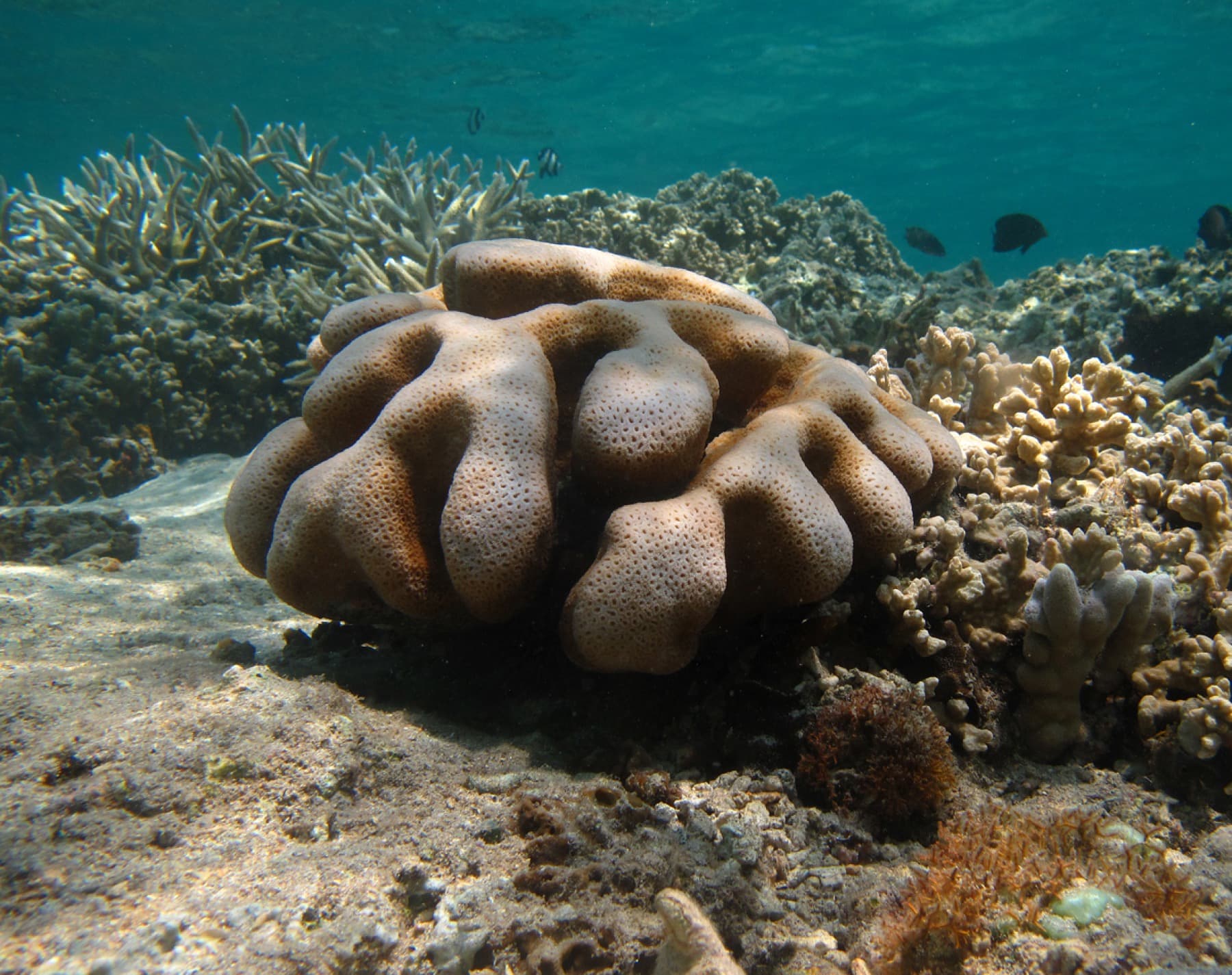
Short Answer
- Cyphastrea often shows more separated star-like polyps on a contrasting base.
- Encrusting Montipora often has smaller, tighter SPS polyps and a smoother sheet-like growth edge.
- Cyphastrea is often kept in lower-to-moderate light than many Montipora, but care context alone does not prove ID.
- A macro photo of the surface plus a side photo of the growth edge is the most useful evidence.
The main difference is the surface pattern
Cyphastrea often looks like individual polyps or stars set into a colored base. Encrusting Montipora often looks more like a thin SPS sheet with smaller polyps across the surface.
The distinction is easiest at the growing edge. Cyphastrea may show a bumpy, starry texture, while Montipora often spreads as a thinner mat with a cleaner rim.
Cyphastrea vs encrusting Montipora comparison
| Trait | Cyphastrea | Encrusting Montipora |
|---|---|---|
| Polyp spacing | Often more separated and obvious. | Often smaller and tighter. |
| Surface texture | Starry, bumpy, or cratered look. | Smoother SPS sheet with small polyps. |
| Growth edge | Can look thicker or more textured. | Often a thin encrusting rim. |
| Care clue | Often lower-to-moderate light tolerant. | Often moderate-to-high SPS light tolerant. |
Photo method for this comparison
- Take a reduced-blue macro of the surface so polyp spacing is visible.
- Take a side-angle photo of the encrusting edge.
- Do not crop out the rock edge; growth behavior is useful evidence.
- Compare photos over 2-4 weeks if the frag is newly glued and not yet spreading.
The three-photo test for this lookalike pair
- A straight-on macro to show whether polyps look separated and star-like.
- A side or angled shot to show the thickness of the growing skin.
- A reduced-blue image of the newest edge where growth is actively spreading.
Use care context carefully
Cyphastrea is often placed in lower light zones than many Montipora, while encrusting Montipora is often treated like SPS. That helps interpret the coral, but placement history is not an identification proof.
If the coral changes color after moving to stronger light, do not rename it from color. Recheck surface structure and growth edge.
Try Coral Identifier on your own tank photos
Capture a clear photo, review likely matches, and build better coral ID confidence over time.


Coral database
Compare the coral profiles
Continue with the structured identification, lookalike, placement, and care references for the corals discussed in this guide.
Meteor Shower Cyphastrea
Cyphastrea spp.
Identify Meteor Shower Cyphastrea by encrusting base and raised contrasting polyps; then set low placement, moderate flow, and enough separation from Leptastrea Coral and Encrusting Montipora.
Open profile →Encrusting Montipora
Montipora spp.
Use this Encrusting Montipora profile to compare thin encrusting SPS mat with Meteor Shower Cyphastrea and Leptoseris Coral, plan conservative spacing, and watch for paling, base recession, or lost polyp extension under high flow.
Open profile →Sources
References and further reading
FAQ
Frequently asked questions
01How do I tell Cyphastrea from encrusting Montipora?+
Compare polyp spacing and surface texture. Cyphastrea often has more separated star-like polyps, while Montipora often has smaller tighter polyps on a smoother encrusting sheet.
02Can Cyphastrea grow over rock like Montipora?+
Yes. Both can encrust over rock, which is why the surface close-up and growth edge are important.
03Is lighting enough to identify Cyphastrea?+
No. Cyphastrea is often kept lower than many Montipora, but placement is only supporting context.
04What photo helps most?+
A reduced-blue close-up of the surface and a side-angle photo of the growth edge are the most useful pair.