
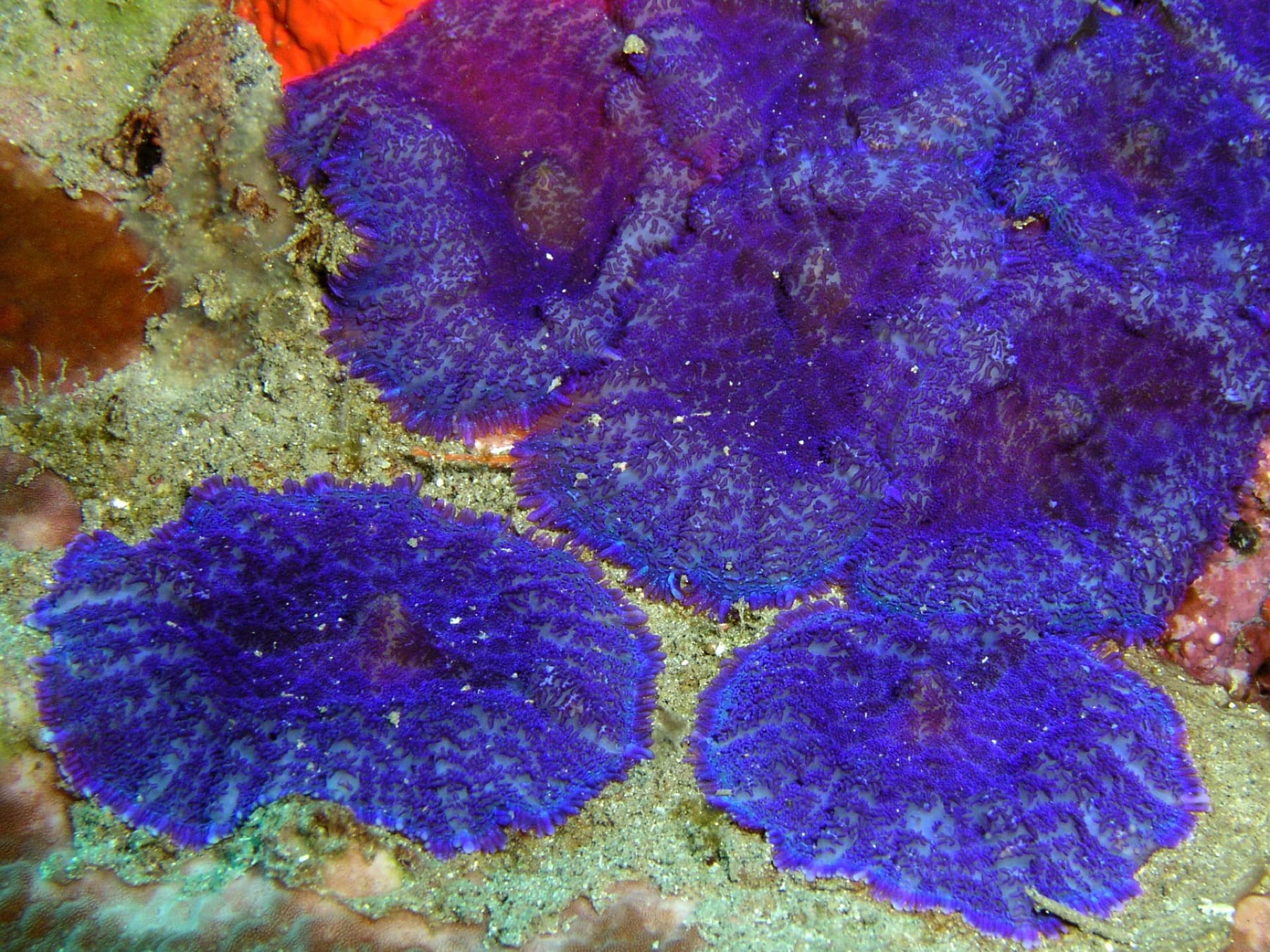
Short Answer
- Discosoma is often smoother and flatter, with a simpler disc surface.
- Rhodactis usually looks more textured, fuzzy, or frilly across the surface.
- Ricordea often shows bubble-like vesicles, especially around the disc and mouth area.
- Do not identify mushrooms by color alone; lighting and strain names make color unreliable.
Identify mushroom corals by surface texture first
Most mushroom corals flatten against rock and can change shape during the day. That makes outline less reliable than surface texture and mouth structure.
A smooth disc suggests Discosoma-type mushrooms. A bumpy, frilly, or fuzzy surface suggests Rhodactis-type mushrooms. A surface covered in bubble-like vesicles suggests Ricordea-type mushrooms.
Common mushroom coral types
| Type | Typical look | Common trap |
|---|---|---|
| Discosoma | Smooth or lightly textured disc. | Bright color morphs can distract from smooth structure. |
| Rhodactis | Hairy, frilly, bumpy, or more textured disc. | Some closed Rhodactis look smoother than usual. |
| Ricordea | Bubble-like vesicles across the surface. | Blue light can blur vesicle shape into glow. |
| Bounce mushroom | Large inflated vesicles in designer strains. | Trade-name confidence usually requires lineage. |
Care clues that change mushroom appearance
- Many mushrooms tolerate low-to-moderate light, often around 50-150 PAR, but named strains vary.
- Low-to-moderate flow helps the disc stay expanded without folding constantly.
- A stretching mushroom may be reaching for light; a shriveled one may be irritated, shaded, or adapting.
- Multiple mouths, splitting, or pedal laceration can change shape and confuse ID photos.
Spread behavior is part of the ID
Mushroom corals are often identified from a single disc, but the way they spread over weeks is useful evidence. A coral that detaches, drifts, and reattaches behaves differently from a mat-forming soft coral or a stony encruster.
- New baby discs near the base support mushroom-type growth.
- A loose disc that moves around the rock is more consistent with many mushrooms than with LPS or SPS.
- Rapid spread can affect placement even when the coral is easy to keep.
Photo workflow for mushroom ID
Take one top-down photo for disc shape and one angled close-up for texture. If you are comparing Ricordea and Rhodactis, use reduced-blue lighting so the bumps are visible rather than just fluorescent.
Try Coral Identifier on your own tank photos
Capture a clear photo, review likely matches, and build better coral ID confidence over time.


Coral database
Compare the coral profiles
Continue with the structured identification, lookalike, placement, and care references for the corals discussed in this guide.
Mushroom Coral
Discosoma spp. / Rhodactis spp.
Mushroom Coral care and ID profile for single fleshy disc, central mouth, disc shrinking or detaching, and practical placement decisions for mixed reef compatibility.
Open profile →Ricordea Mushroom
Ricordea florida / Ricordea yuma
Identify Ricordea Mushroom by round fleshy disc and bead-like vesicles; then set low placement, low flow, and enough separation from Mushroom Coral and Zoanthids.
Open profile →Rhodactis Mushroom
Rhodactis spp.
Use this Rhodactis Mushroom profile to compare textured fleshy disc with Mushroom Coral and Hairy Mushroom Coral, plan conservative spacing, and watch for disc shrinking or detaching under low flow.
Open profile →Sources
References and further reading
FAQ
Frequently asked questions
01How do I identify a mushroom coral?+
Look at surface texture, mouth structure, and disc shape. Smooth discs suggest Discosoma, frilly texture suggests Rhodactis, and bubble-like vesicles suggest Ricordea.
02Are mushroom corals soft corals?+
In reef aquarium language they are usually treated with soft-coral care context because they lack the hard branching or wall skeleton of stony corals.
03Do mushroom corals need feeding?+
Most photosynthetic mushrooms do not require heavy target feeding, but occasional fine meaty foods may be accepted. Avoid overfeeding and watch nutrient levels.
04Can AI identify mushroom coral morph names?+
AI may suggest a likely group, but designer morph names usually need lineage, seller context, and stable photos. Do not rely on one photo for a strain name.