
Short Answer
- Ricordea usually show bubble-like vesicles rather than a smooth or hairy disc.
- Discosoma is often smoother; Rhodactis is often fuzzier, frillier, or more irregular.
- Ricordea florida and Ricordea yuma are often separated by mouth/vesicle pattern, but photos must be clear.
- Color alone cannot prove Ricordea or a specific strain.
The core difference is the disc surface
A Ricordea usually looks like a mushroom covered in small rounded bubbles. Those vesicles are the first thing to inspect before color or trade name.
Other mushroom corals can be smooth, hairy, frilly, or bumpy, but the Ricordea look is usually more bead-like across the disc.
Ricordea, Discosoma, and Rhodactis in photos
Compare an expanded disc first. These reference images show useful textures, but individual mushrooms vary and a contracted specimen can hide the same features.
| Group | First visible clue | Common trap |
|---|---|---|
| Ricordea | Many rounded, bead-like vesicles across the disc. | Bubble-like bumps alone do not establish florida or yuma. |
| Discosoma | A broad disc, often with relatively low surface relief. | Some Discosoma are textured; do not require a perfectly smooth surface. |
| Rhodactis | Often shaggy or irregular projections across the disc. | Contraction can make an open, hairy-looking disc appear smooth. |
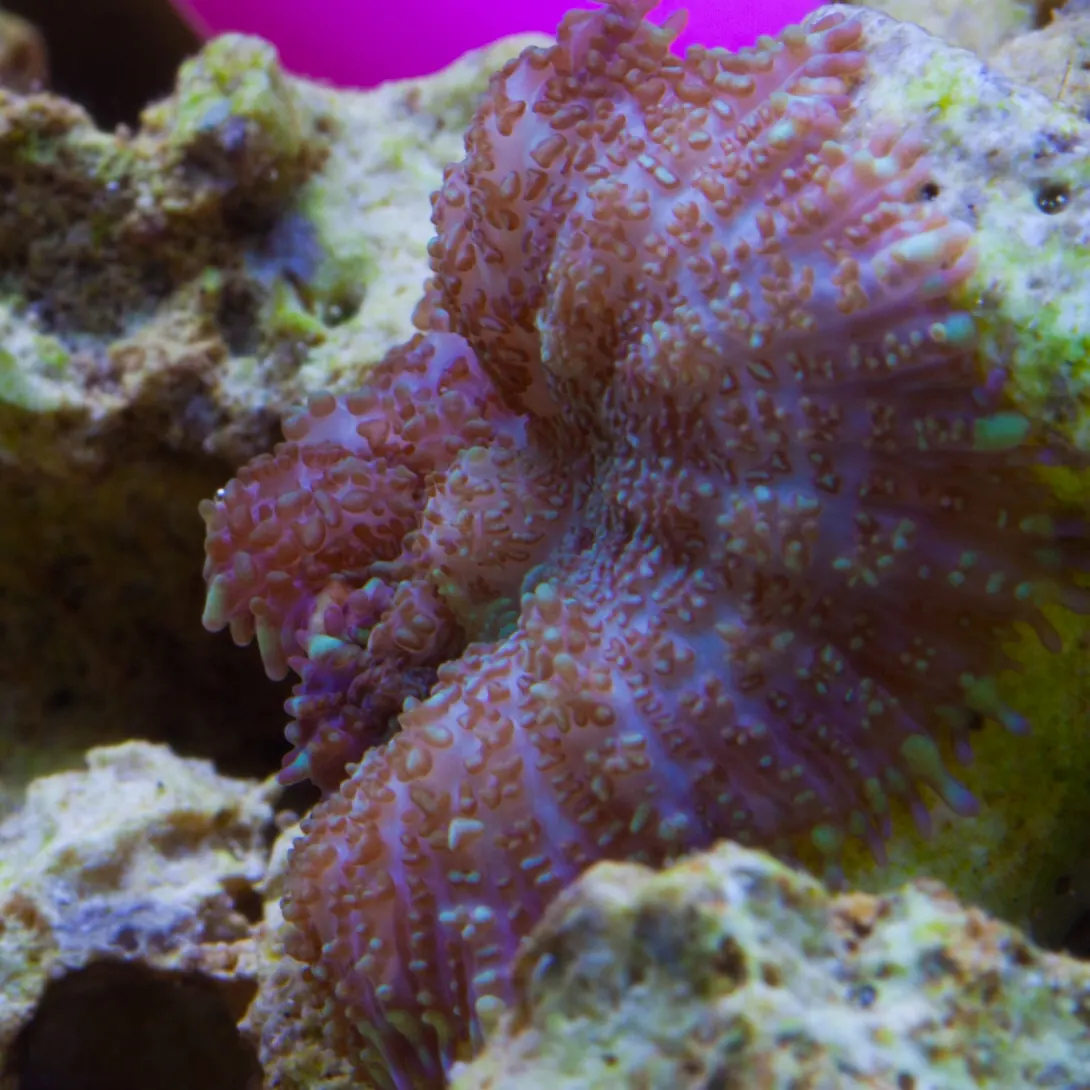
Ricordea: rounded vesicles across the disc
Follow the rounded projections across the disc toward the mouth. This reference is labeled Ricordea yuma; the photograph illustrates texture, not a color rule for identifying every yuma.
Photo: Will Thomas · CC BY 2.0
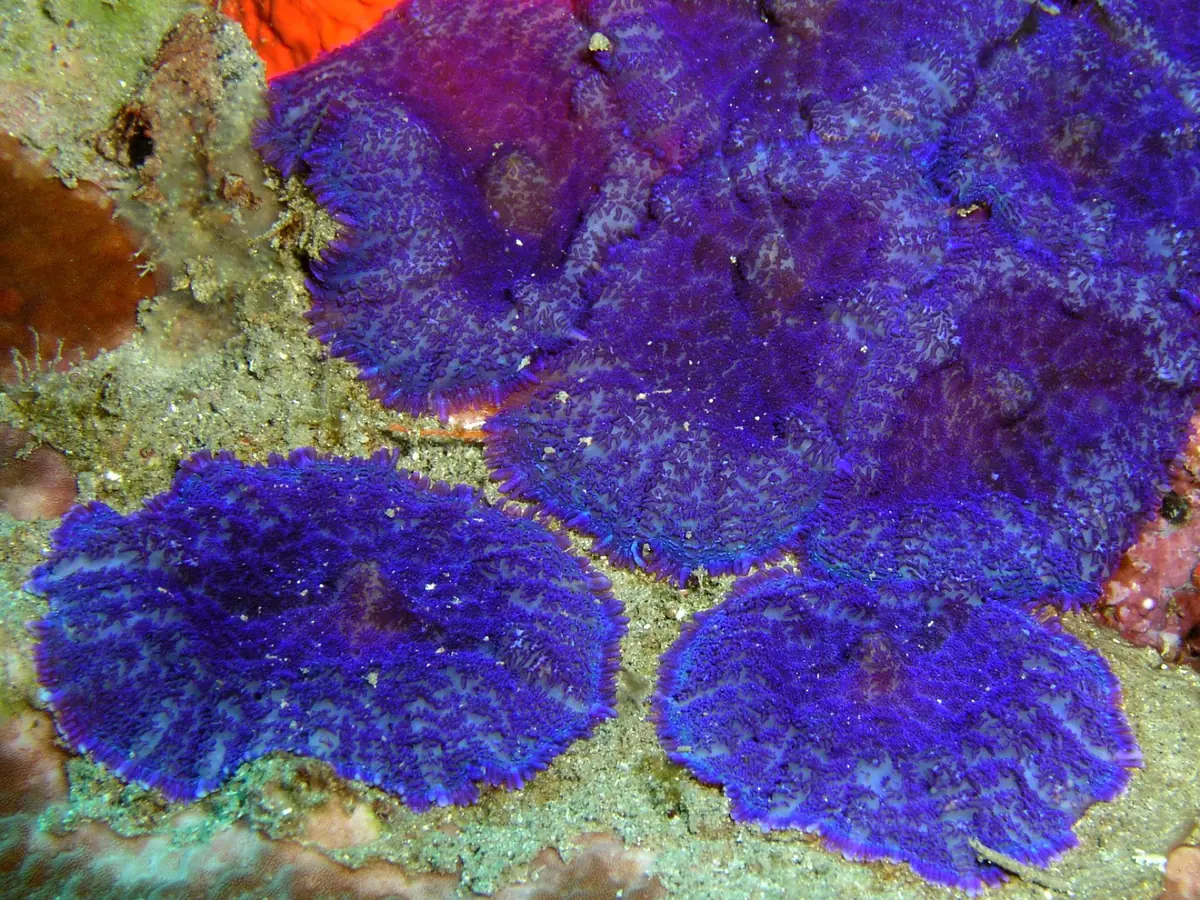
Discosoma: broad discs with low surface relief
Look at the broad, mostly flat discs and central mouth areas. These mushrooms still have small surface projections: smoother does not mean perfectly smooth. Compare the height and distribution of texture, not the blue color.
Photo: Nick Hobgood · CC BY-SA 3.0
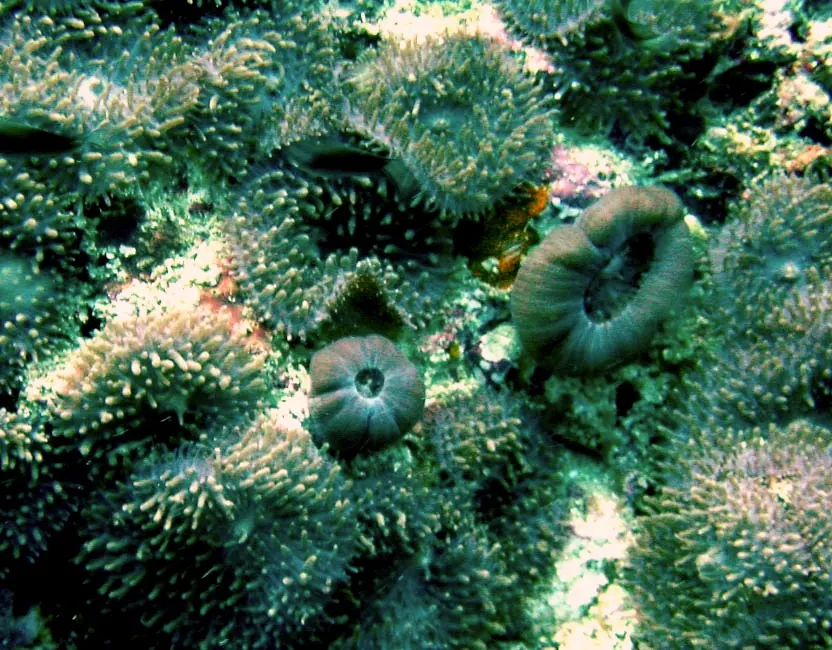
Rhodactis: shaggy texture and contracted discs
The open discs show dense, irregular projections; the contracted discs near the center look much smoother. This is why a closed mushroom should be photographed again after normal expansion.
Photo: Chaloklum Diving · CC BY-SA 4.0
A faster diagnostic sequence
For Ricordea, a short sequence often works better than a table because the important clue is the texture across the disc.
- First check whether bumps or vesicles cover most of the oral disc.
- Then inspect the mouth area: Ricordea yuma often has bumps close to the mouth, while Ricordea florida often shows a cleaner mouth zone.
- Next compare the edge: ordinary Discosoma often looks smoother and flatter than Ricordea.
- Finally use behavior and growth over time; one contracted photo can make several mushroom types look similar.
Ricordea florida vs yuma: compare the mouth and disc
Tidal Gardens describes two useful aquarium observations: yuma often has vesicles close around the mouth and alternating rows of larger and smaller projections; florida often has a clearer mouth zone and a less orderly distribution. These are comparison clues, not a guaranteed diagnosis from one image.
Photograph the expanded mouth area and the whole disc under the same lighting. If that area is folded, overexposed, or closed, retain a Ricordea-level label. Color and a seller’s trade name do not resolve the uncertainty.
Photo method for Ricordea ID
Use a top-down photo for the disc and a reduced-blue close-up for surface texture. If the bubbles are blown out by fluorescence, lower exposure and retake the image.
Try Coral Identifier on your own tank photos
Capture a clear photo, review likely matches, and build better coral ID confidence over time.




Coral database
Compare the coral profiles
Continue with the structured identification, lookalike, placement, and care references for the corals discussed in this guide.
Ricordea Mushroom
Ricordea florida / Ricordea yuma
Identify Ricordea Mushroom by round fleshy disc and bead-like vesicles; then set low placement, low flow, and enough separation from Mushroom Coral and Zoanthids.
Open profile →Mushroom Coral
Discosoma spp. / Rhodactis spp.
Mushroom Coral care and ID profile for single fleshy disc, central mouth, disc shrinking or detaching, and practical placement decisions for mixed reef compatibility.
Open profile →Sources
References and further reading
FAQ
Frequently asked questions
01Is Ricordea a mushroom coral?+
Yes. In reef aquarium language, Ricordea are usually treated as mushroom corals, but they are often separated because their bubble-like vesicles are distinctive.
02How do I identify Ricordea?+
Look for a disc covered in small rounded vesicles. Use reduced-blue lighting so the surface texture is visible.
03Can AI tell Ricordea florida from yuma?+
It may suggest a likely match from a clear photo, but species-level confidence is weak without good mouth-area detail and reliable context.
04What light do Ricordea need?+
Many Ricordea do well in low-to-moderate reef lighting, often around 50-150 PAR as a cautious starting range, with slow acclimation.