
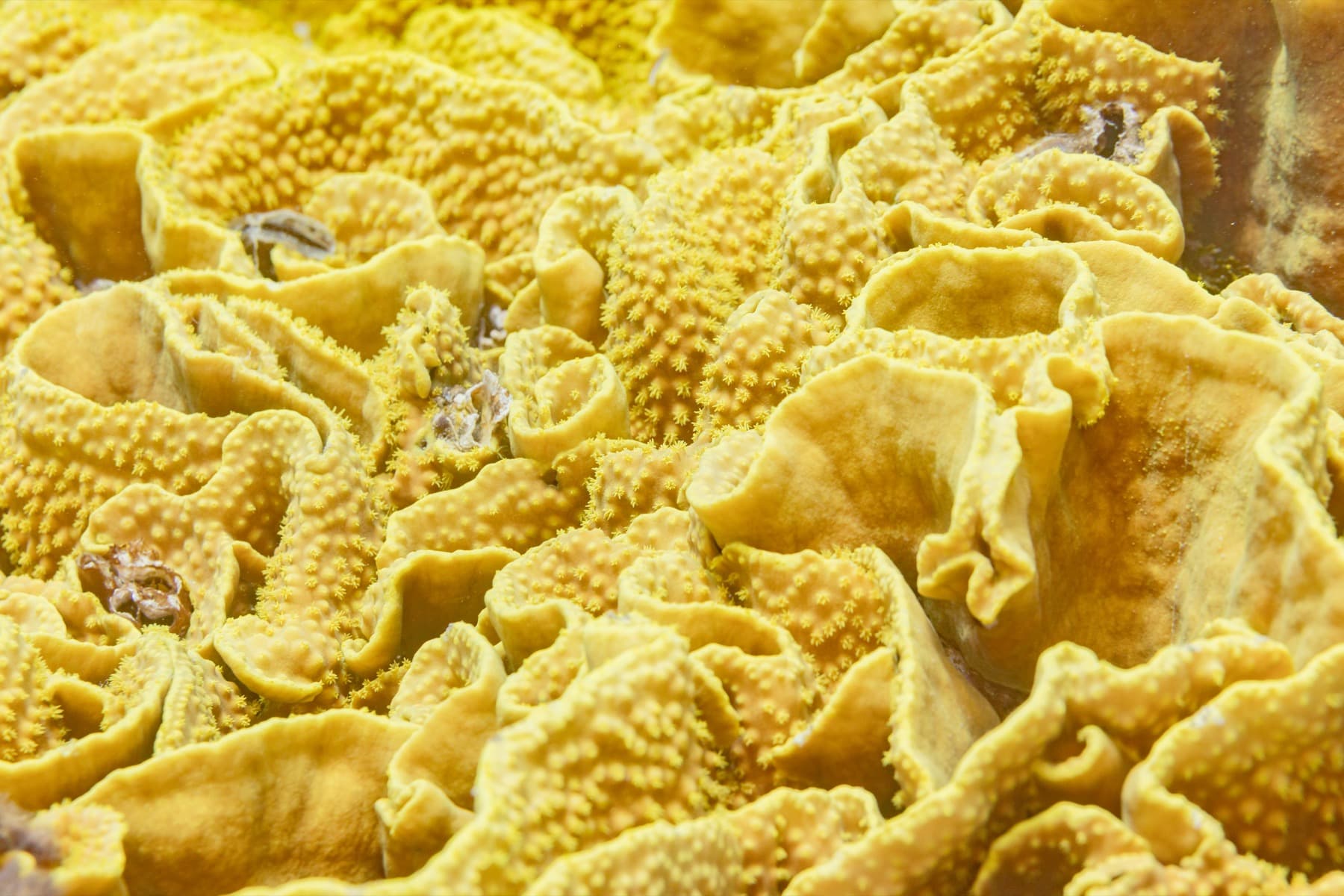
Short Answer
- Plating is a shape, not a genus.
- Montipora plates usually show small SPS polyps and thin growth rims.
- Chalice-style plates usually look fleshier and show eyes or mouths.
- The growth edge and surface close-up are the two most important photos.
Plating is not enough for an ID
Many reef keepers say plate coral when they mean a coral growing as a shelf. That growth form is useful, but it does not tell you whether the coral is SPS, LPS, or another group.
Start by asking whether the surface looks like small SPS polyps, fleshy LPS tissue, visible eyes, or delicate thin sheets.
Plating coral comparison
| Likely group | Surface clue | Growth edge clue |
|---|---|---|
| Plating Montipora | Small polyps and thin SPS texture. | Thin rim or cap edge. |
| Chalice-style LPS | Fleshy tissue with eyes or mouths. | Thicker or more irregular plate. |
| Leptoseris-type | Thin delicate plating with fine texture. | Very thin sheets or folds. |
| Favia/Favites-type | Corallites or walls more obvious. | May encrust or mound rather than plate cleanly. |
Photo workflow for plating corals
- Take a side photo showing plate thickness.
- Take a close-up showing polyps, eyes, or corallites.
- Photograph the newest growth rim.
- Avoid ID from only a glowing top-down photo.
The two-angle rule for plating corals
- Top-down shows color and surface pattern, but often hides thickness.
- Side angle shows whether the plate is thin SPS-like, fleshy LPS-like, or folded into a cup.
- A close-up of the growth rim is usually more useful than a saturated fluorescence photo.
Care caution for plating corals
Care differs widely. Plating Montipora is often treated as SPS and may like stronger light and flow. Chalice-style plates are often treated as LPS with more cautious light and spacing.
Try Coral Identifier on your own tank photos
Capture a clear photo, review likely matches, and build better coral ID confidence over time.
Identify on the App StoreSources
References and further reading
FAQ
Frequently asked questions
01What is a plating coral?+
Plating describes a coral growth form where the colony grows outward as shelves or plates. It is not a specific genus.
02How do I tell plating Montipora from chalice?+
Montipora usually has small SPS polyps and a thin rim, while chalice often has fleshier tissue and visible eyes or mouths.
03Can plating corals be LPS?+
Yes. Some chalice-style LPS corals plate or encrust, so growth form alone is not enough.
04What photo helps identify plating coral?+
A side-angle image of plate thickness plus a close-up of surface texture and mouths/polyps.